A stormwater management system is essential for maintaining a safe and healthy community by lowering the risk of flooding that can damage property and the environment.
In order to reduce the negative effects of stormwater, towns and cities like Newmarket create control facilities, such as storm sewers and stormwater ponds. Newmarket also takes proactive steps to minimize the pollution of stormwater through street sweeping and catch basin cleaning.
The Town maintains more than 251 kilometres of storm sewers and over 7,000 catch basins. To date, Newmarket has 62 Stormwater Management Facilities (including wet ponds, dry ponds and underground storage). Newmarket also has 38 Oil and Grit separators that remove oil and sediment from stormwater in areas where a stormwater pond does not exist to help manage stormwater.
Newmarket has completed several stormwater management and Low Impact Development (LID) projects. There are also some steps you can take as a resident to support our goals.
On this page
What can I do?
Here are a few easy things you can do as a Newmarket landowner or resident to address your stormwater and have a positive effect on the environment.
Ensure downspouts are clear and directed away from the home
Do not change or block swales between homes
Ensure your catchbasin is clear of debris
Low Impact Development Policy
The Town adopted a Stormwater Management and Low Impact Development Policy in 2017. The goal of this policy is to reduce and eventually eliminate the negative effects of stormwater on the built and natural environment. Low Impact Development refers to techniques that mimic how stormwater is handled in the natural world.
This policy declares that the Lake Simcoe Region Conservation Authority's Technical Guidelines for Stormwater Management Submissions will apply to all public and private development and redevelopment within the Town of Newmarket. It includes submission requirements, design criteria, stormwater targets, and maintenance requirements.
The Town piloted a demonstration project for Low Impact Development as part of a municipal road improvement project on Forest Glen Road, north of Queen Street. The goal was to implement LID stormwater drainage solutions to improve water quality (including phosphorus removal), reduce erosion at Western Creek, increase infiltration and groundwater recharge, and provide maximized flood control while offering a landscape aesthetic and streetscape element. This project is now complete and was completed in partnership with the Lake Simcoe Region Conservation Authority.
Learn more about the Low Impact Development on Forest Glen Road by watching the video below.
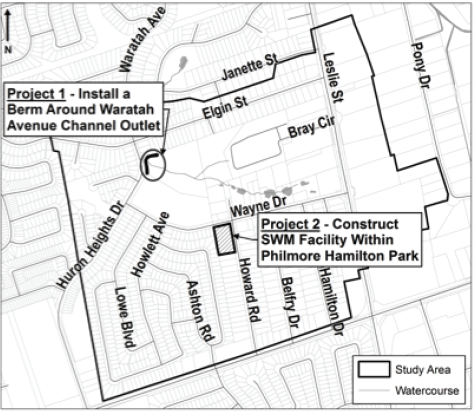
Wayne and Waratah Stormwater Management Study
The Town completed a Municipal Class Environmental Assessment (EA) Study to develop a stormwater management (SWM) strategy addressing flooding concerns in the Wayne Drive and Waratah Avenue Area (See Study Area Map). The EA study defined problems and opportunities, considered and evaluated solutions, and identified the best options. The study followed the Master Planning Process of the Municipal Engineers' Association Municipal Class EA Approach #2, which fulfills the requirements for Schedule B projects.
Two Public Information Centres were held at the Town offices on October 16th, 2016 and May 18th, 2017.
The preliminary preferred SWM strategy identified two Schedule B projects whose requirements are satisfied under this Master Plan.
Project 1: Install a berm around Waratah Avenue Channel Outlet with improved inlet control structure.
Project 2: Construct a SWM facility within Philmore Hamilton Park.
The Town piloted a new process of including the public in the planning and redesign of infrastructure and local services. Our goal is to integrate the design of stormwater management with the development of recreational opportunities in underused public spaces. We aim to address water quality and quantity while increasing access to recreation in a way that meets your needs and interests.
Image
The first step was the public iWonder Event held on January 27th, 2018 at the Lions Hall Community Centre, where residents were invited to a multi-sensory, interactive event to provide feedback and inform innovating engineering solutions.
Lions Park drainage improvements
The Town completed a Schedule B Municipal Class Environmental Assessment study looking to improve surface water drainage and create recreational space within Lions Park, as well as wildlife habitat within D'Arcy Creek. Approximately 2 hectares of surrounding land was draining into Lions Park, creating flooding issues and unusable recreational space.
This project is now complete. The final design included:
Rehabilitation of the watercourse including cleanout, widening, profile adjustments and riparian buffers.
Development of an approximately 2,000 m2 wetland within the west portion of Lions Park including plantings, signage, and walkway.
Placement of the excavated material within the east portion of the park to reduce flooding.
This project was conducted in partnership with Lake Simcoe Region Conservation Authority and Environment and Climate Change Canada. Support was also provided by York Region's Greening Partnership Action Fund and Dufferin Simcoe Land Stewardship Network.
CB Shield Catch Basin Project
As part of our ongoing efforts to adapt to climate change, the Town conducted a water quality pilot project for stormwater management. The project involved placing a product called CB Shield in seven catch basins located on the south side of John Bowser Crescent and Glenway Circle. CB Shield is designed to change the flow of stormwater entering a catch basin to improve the settling of sediment and the phosphorus that is attached to it. The project tested the effectiveness of the CB Shield product and consists of a monitoring program in partnership with the Lake Simcoe Region Conservation Authority (LSRCA).
The Town's use of sand for winter road maintenance, along with buildup of trash and organic debris such as leaf litter, results in sediment that washes into the Town's stormwater infrastructure. The sumps at the bottom of catch basins have a limited sediment storage capacity. As a result, sediments that are resting in the sump can sometimes be disturbed and re-suspended into the stormwater during major rain storms. Sediment and phosphorus make up a significant portion of material that washes into the stormwater system and are two major contributors to poor water quality in our stormwater ponds, lakes, and rivers.
Catch basins with CB Shields installed were found to have collected significantly more sediment after three years than the corresponding controls without CB Shields. Each CB Shield monitoring location and adjacent control point will have a measuring device installed by the LSRCA monitoring team to record the buildup of sediment at each location on a seasonal basis.
Ray Twinney Low Impact Development Retrofit
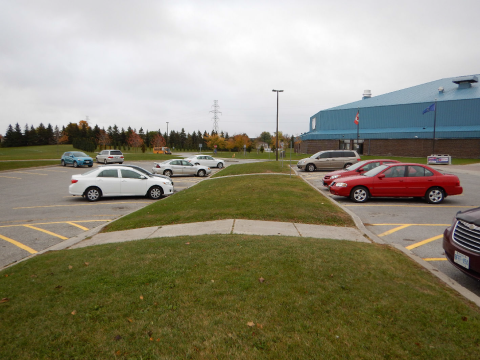
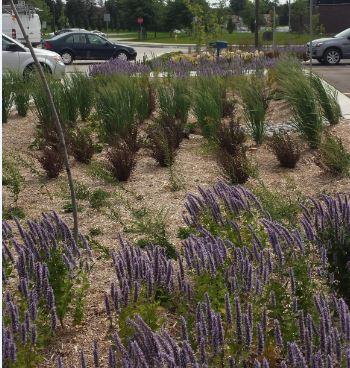
The Town made environmental improvements to the front parking lot at the Ray Twinney Recreation Complex, in partnership with Lake Simcoe Region Conservation Authority and Environment and Climate Change Canada. Improvements include stormwater management using Low Impact Development techniques, such as permeable interlocking pavers in the parking lot and the installation of rain gardens in the median areas. These retrofits will improve downstream water quality and reduce flooding in the Western Creek by allowing water to infiltrate into the ground naturally. There is 500 cubic metres of storage under the parking lot and garden area for rain water.
This project is now complete—swing by the Complex to check out the improvements. Before and after photos are highlighted below.
Image
Image
Stormwater Management Facility Maintenance Program
The Town developed a Stormwater Management Facility (SWMF) Maintenance Program for all Town-owned and -operated stormwater facilities. The main goal was to complete an inventory and survey of these facilities, creating a detailed SWMF Inventory and Maintenance Needs Plan. The program includes an annual inspection of Town SWMF to identify short- and long-term maintenance requirements.
Comprehensive Stormwater Management Master Plan
The Lake Simcoe Protection Plan (LSPP) identified urban stormwater runoff as a significant source of phosphorus entering Lake Simcoe and its tributaries. As a result, the LSPP requires municipalities to prepare and implement a Comprehensive Stormwater Management Master Plan (CSWMMP). The Town of Newmarket has completed its Master Plan, which provides an integrated assessment of existing and proposed future conditions with respect to stormwater management within the Town. The report also details opportunities for improvement and recommendations for future actions.
For a copy of the report, please email the Town at info@newmarket.ca or call 905-895-5193.