
Inflow and infiltration (I/I) happens when water from the environment enters the sewage system for treatment. Inflow and infiltration describe two situations:
- Inflow is when there is a rapid flow of storm water in the sanitary sewer system.
- Infiltration is the gradual downward flow of water from the surface of the earth into the soil and the wastewater collection system.
I/I occurs through cracks or holes in the pipe network or inappropriate connections such as catch basins or roof down spouts. I/I increases the flow and volume in the sanitary sewer and reduces the capacity of the pipe and the treatment plant. The result is a higher risk of overloading the pipe network. This can lead to potential basement flooding.
There are two sewer systems in Newmarket:
- The sanitary sewer system collects wastewater produced by houses, businesses, and institutions. The system directs the wastewater to a treatment plant. At the treatment place, the water is treated before being discharged into Lake Ontario.
- The storm sewer system collects rainwater runoff. During storm events, rainwater soaks into pervious areas, such as grassed lawns and gardens. Rainwater that does not soak into the ground will turn into runoff. Runoff flows through impervious areas, such as roads and parking lots. Catch basins and other inlets to collect the rainwater runoff and move the water through a storm sewer system. Rainwater, unlike wastewater, does not need to be treated by a plant.
Having a storm and sanitary sewer system allows us to separate these flows before treatment and discharge to the environment.
On this page
Inflow and infiltration (I/I) reduction study
The Town of Newmarket is working with Civica Infrastructure Inc. on an inflow and infiltration reduction study. The study’s objectives are to identify sources of I/I entering the sanitary sewers. Once identified, the study will develop a plan to reduce these “extraneous” flows. A flow monitoring program with field-testing is being done to identify sources of I/I entering sanitary sewers. The program will identify general areas within the Town that have increased I/I. Additional field-testing will then be conducted in these areas to identify the specific sources of I/I. The field-testing includes fog and dye testing and CCTV inspection.
Fog and Dye Testing in Sewers
The Town of Newmarket will be working with Civica Infrastructure to complete fog and dye testing in the sewers in your neighbourhood. Fog and dye testing is a safe and easy way to locate any sources of inflow and infiltration in the system.
For more information on Fog and Dye testing, please view the Fog and Dye Testing FAQ [PDF/2.1MB].
Fog testing
The fog testing involves of blowing a harmless coloured fog into manholes and pipes and observing where the fog exits from the system. The fog is expected to exit out of manholes on the street and plumbing ventilation stacks at the top of buildings.
It is also possible for fog to exit stormwater catch basins and roof down spouts at the side of a house. This indicates possible inappropriate connections to the sanitary sewer.
The fog used in the test has no odour and is not harmful to your health, and will disappear after a few minutes.
Notices will be distributed to residents in areas where fog testing will be occurring. When you get the notice for fog testing, please pour one pail of water into any drains (including your basement drain) that you do not frequently use.
On the day of testing, Civica Infrastructure staff will visit each building to notify them that testing is happening. There is no need to be home during testing, and there is no need to enter the building to conduct the test. Civica Infrastructure staff will be wearing a company name tag and will be on site during the entire process of the testing.
Call Civica Infrastructure at 905-417-9792, if you have a health condition you think may be affected by the testing.
Dye testing
Dye testing is used to find where rain or groundwater may be entering the sanitary sewer system. This process using a non-toxic, biodegradable dyed water. This water is introduced into roof leaders, driveway drains or catch basins. After introducing the dyed water, the downstream sanitary sewer manhole is checked.
Dye testing is one way of determining where a pipe or structure drains to, if it is not obvious by observation or on existing plans or records. By conducting dye testing, inappropriate connections can be identified. For instance, if a dye is introduced to a catch basin and the dye is then observed in the sanitary sewer downstream from that point, this would suggest that the catch basin is directly connected to the sanitary sewer system.
The dye is non-toxic, biodegradable and poses no harmful effects to humans, wildlife or the environment. The dye does not permanently stain and washes away with water. The dye is fluorescent green. The dyed water is poured into the sanitary system or roof drain leaders, making it unlikely that anyone will come into contact with the dye.
Signs will be displayed along outfalls of the storm sewer system, such as rivers and creeks. Do not be alarmed if you observe a green liquid entering a waterway in your area, or if your waterway is green during testing periods.
The resident of each property will be informed 1 week before testing by a door hanger notice. Civica Infrastructure representatives will also notify residents on the day of testing.
On the day of testing, our field crews will need to access the exterior of your property. They do not need access to your home. There are no other measures you need to take before dye testing.
Fog and dye testing in Newmarket
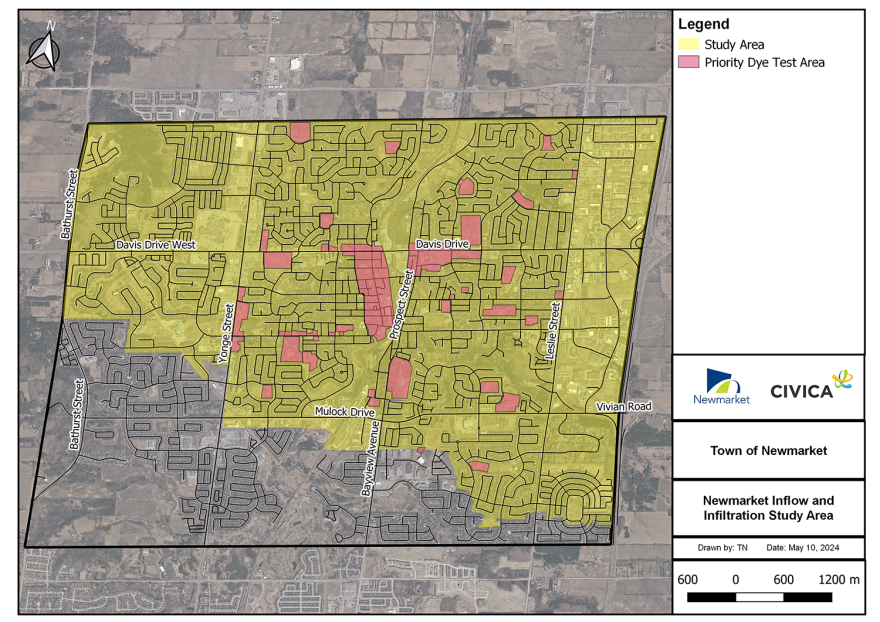
Exterior property assessments in your neighbourhood
Civica Infrastructure will be conducting exterior property assessments in select neighbourhoods between the hours of 9 a.m. to 5 p.m.
Exterior property assessments are visual assessments of the outside of your home to note any drainage features that may discharge to the sanitary sewer. Common drainage features include:
- Roof down spouts
- Basement access drains
- Driveway drains
Civica Infrastructure staff will walk around the exterior of your property and note any drainage features that do not drain to the surface. Exterior lot assessments typically take less than 10 to 15 minutes to complete. Staff will not need to enter inside your house to conduct the assessment.
On the day of the assessment, Civica Infrastructure staff will knock on the resident’s door and inform them that the exterior property assessment will be occurring. You do not need to be home for the exterior property assessment, but you can be home while the assessment is occurring.
Project contacts
- Tejiri Nikoro, Project Coordinator, Civica Infrastructure, 905-417-9792 ext. 2336, tnikoro@civi.ca
- Nirujaan Kanagendran, Project Coordinator, Civica Infrastructure, 905-417-9792 ext. 2303, nkanagendran@civi.ca (Main Contact)