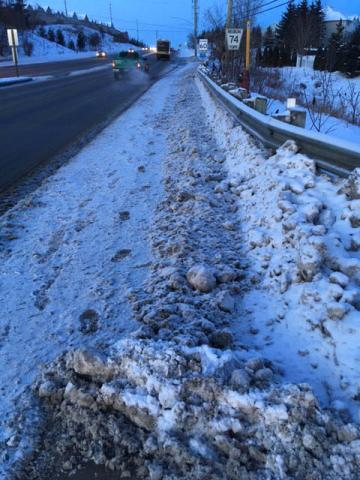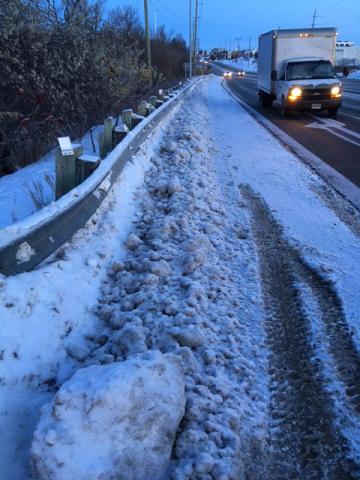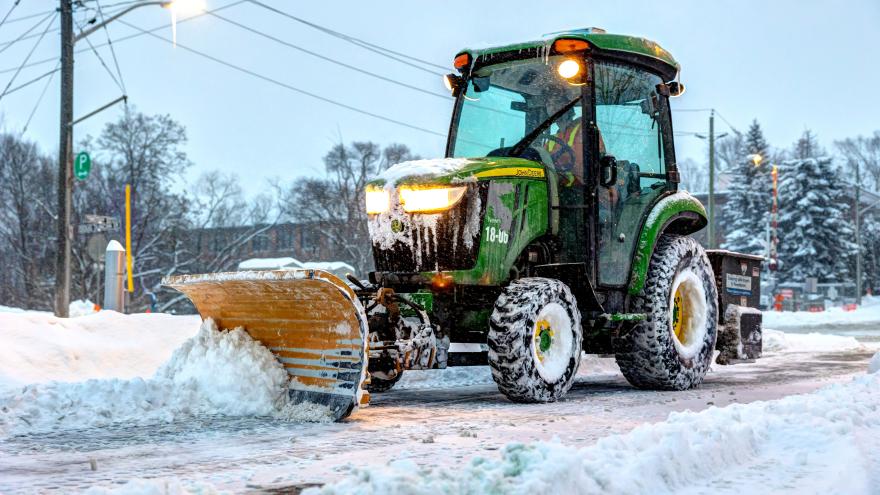
Unfortunately, the Town cannot grant this request. The Town is obligated by Ontario's Minimum Maintenance Standards 239/02 to clear all sidewalks in Newmarket for the safety of our residents.

Newmarket aims to clear 100 per cent of all sidewalks, walkways, and paved trails in Newmarket as established in our Sidewalk Snow-Clearing Program.
Property owners are encouraged to help the Town by clearing sidewalks adjacent to their property, as a support to the Town’s winter maintenance. Be a good neighbour and lend a hand to those who are physically unable to shovel or have difficulty leaving their home due to snow or ice. Remember not to shovel snow onto the street.
Sidewalks in subdivisions that have not been assumed by the Town will not be cleared—developers are required to clear sidewalks in unassumed areas. Property owners in subdivisions are asked to clear the sidewalk adjacent to their property.
Please do not park over a sidewalk, this is a violation of the Town's parking By-law and you may be subject to a fine.
Sidewalk clearing routes are separated into primary routes and secondary routes. Primary routes will be cleared first, and secondary routes will be cleared once primary routes are completed. Snow plowing begins when more than 6 cm of snow has fallen.
Primary routes are sidewalks on major roads such as Davis Drive, Yonge Street, Leslie Street, Mulock Drive and Bayview Street. Also included are the Tom Taylor Trail and routes that lead to the hospital, schools, major business areas, and major transit locations. Secondary routes are usually those on residential streets.
Clearing primary routes can take up to 24 hours to complete and even longer if snow continues to fall.
Property owners are encouraged to take the following steps to prepare for winter, both to prevent damage to their property and to allow snow plows to pass by easily.
Sidewalk plows need to be the same size of the sidewalk in order to effectively clear as much snow as possible. If there is overgrown sod on the sidewalk, it can get caught on the plow blade, causing damage to your sod.
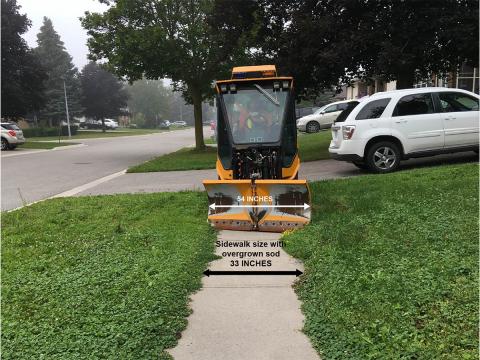
Damage as a result of sod overgrowth is especially likely after a thaw/freeze cycle. When the ground is wet due to the thawing of ice and snow, the sod does not have the opportunity to refreeze fully. The root of the turf is intertwined, so when a plow blade catches an unfrozen lawn, it tends to tear a larger area. Unfortunately, as a result, even the slightest deviation of the plow from the sidewalk can leave significant damage.
The Town of Newmarket makes a conscious effort to minimize damage during sidewalk snow plowing operations. If your sod is damaged during sidewalk snow plowing operations, please fill out the sod repair form or give the Town a call at 905-895-5193. Your name and address will be placed on the Town’s sod repair list. A Town staff member will stop by your property, take photos of the damage and log it into our sod repair system. Sod repair usually takes place in the spring.
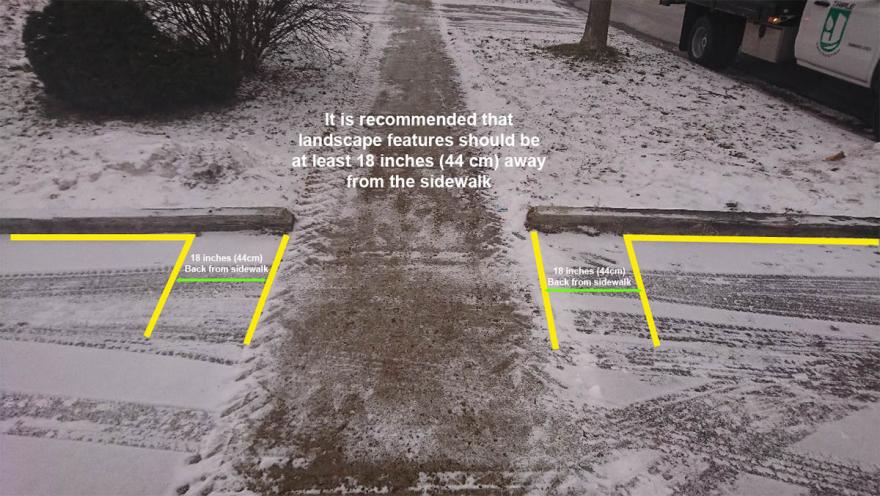
Ontario's Minimum Maintenance Standards 239/02 require that landscape features such as driveway curbs, sprinkler heads, gardens, or shrubs are positioned at least 45 cm (18 in) away from both edges of the sidewalk. This distance ensures that they do not interfere with the clearing of snow. It also creates a safety zone for pedestrians who may need to step off the sidewalk, as well as keeping the operator and your property safe.
If you currently have landscape features that reach the edge of your driveway, please shave the corner to at least 30 degrees to ensure it does not obstruct sidewalk snow clearing operations. The image below depicts landscape features that are too close to the sidewalk and will obstruct sidewalk snow plowing operations.
Sidewalk snow markers (a.k.a. snow stakes) are thin poles you insert into the ground to mark the edges of your lawn when they are covered by snow during the winter. These snow markers act as visual guides for sidewalk snow plow operators and help to prevent damage to sod.
Generally, you can install these markers 8 cm (3 in) from the edge of the sidewalk and spaced 4.5 m (15 ft) along your property wherever a sidewalk snow plow could potentially damage your sod. It is recommended that residents install the sidewalk markers as soon as possible before the ground becomes frozen.
View our guide to properly install sidewalk snow markers on your property