
The vision of the Town of Newmarket's Traffic Mitigation Strategy is to improve road safety and enhance the quality of life in Newmarket for both drivers and vulnerable road users.
The Town has also adopted the "Three E" philosophy when it comes to traffic mitigation:
- Enforcement – including duties performed by the York Regional Police and Town by-law enforcement staff
- Education – including Newmarket's Speed Management Program and Safety Driven education campaign
- Engineering – including issues related to road design on existing roads and planning for future projects
Through our Traffic Mitigation Strategy, the Town is looking to improve upon our "Three E" philosophy and to be transparent and proactive about all traffic initiatives. Public input is an important part of making our Traffic Mitigation Strategy a success. If you have any suggestion on how we can improve our traffic mitigation strategy, please email info@newmarket.ca.
Learn more about our Traffic Mitigation Strategy
The Town of Newmarket uses several measures to slow down traffic and improve overall traffic safety.
Category one measures are solutions that are easier to implement and can change as needed. They include:
- A Speed Management Program
- Pavement marking and signage
- Enforcement
- Road-side improvements
- Lane narrowing (non-construction)
Speed Management Program
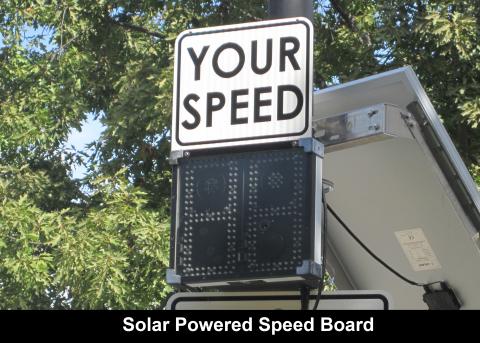
Newmarket's Speed Management Program consists of various radar speed boards to let drivers know how fast they are going and "Safety Driven" branded lawn signs to remind drivers to slow down.
Newmarket has:
- Fourteen solar powered pole-mounted speed display signs
- Boulevard lawn signs (rotated around Town throughout the year)
- Flexible bollards
Pavement markings and signage
Newmarket uses the following pavement markings and signage to help manage speed. These include:
- Yellow centre lines on collector roads to visually divide the roadway and narrow the travel path
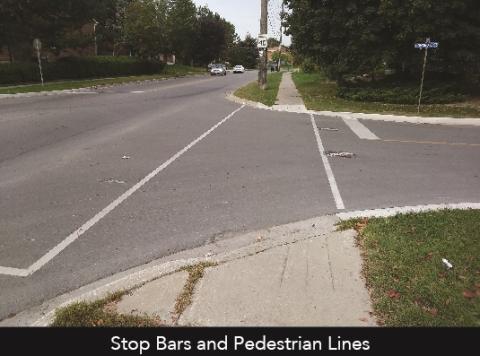
- Stop bars and pedestrian lines at all intersections (where appropriate) to create a visual stop for motorists and provide a path for pedestrians
Enforcement
The Town supports the Road Watch program operated by the York Regional Police. The Road Watch program allows residents to report aggressive or unlawful driving behaviour.
- The Road Watch program is promoted by the Town through:
- A link to the Road Watch website on the Town's website newmarket.ca
- Links to the Road Watch website posted through the Town's Safety Cone Sam Twitter account @SafetyConeSam
- Seven Road Watch signs posted on the major arterial roads leading into the Town
Boulevard improvements (side-friction)
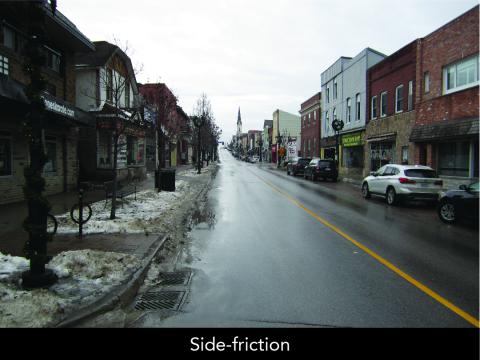
One important traffic calming measure is to provide 'side-friction' on roadways. Side-friction is when objects are placed near the road to make the road appear narrower than it actually is. Narrowing the road helps to slow down vehicles. To achieve this, the Town uses:
- Benches and garbage receptacles placed in key locations
- Trees, landscaping and Low Impact Development (LID) features to reduce the number of 'flat boulevards,' creating the visual effect of a narrower roadway
Lane Narrowing (non-construction)
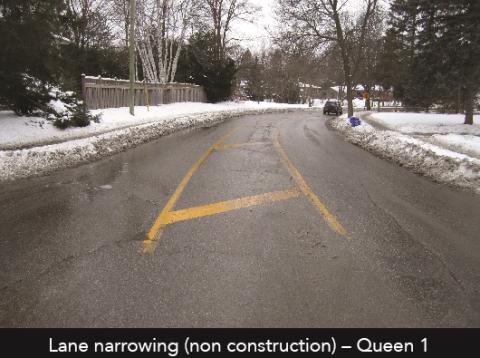
The most common technique to narrow lanes is to apply pavement markings, edge lines and centre-lines.The Town has narrowed two streets (Queen Street and Bristol Road) by placing a painted wide median to 'push' vehicles to the curbs. This makes the lane narrower, providing further separation between vehicles in curved sections. Edge lines are applied along the curb and can be painted as much as 0.5 metres away from the curb.
The Town of Newmarket uses several measures to slow down traffic and improve overall traffic safety.
Category Two measures are solutions that are more permanent and cost more to implement. They include:
- Speed humps (not applicable on roads with bike lanes, paths or trails)
- Curb radius reductions and curb extensions
- Centre medians/pedestrian refuge islands
- S-shaped curb extensions on the road (called chicanes)
- Lane narrowing (construction)
Speed Humps
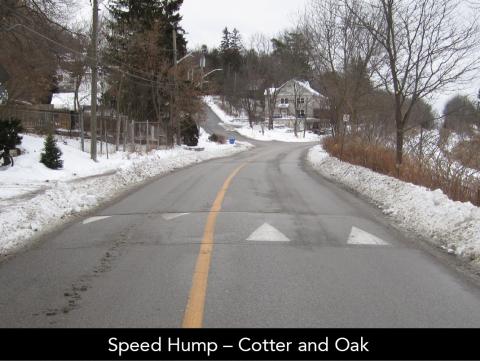
The Town has used speed humps in two areas: Kingston/Malton/Lancaster and Cotter/Oak. When it comes to speed humps, the Town focuses on location, their design requirements and how they are placed (most effective if properly spaced and in groups of three to four).
Speed humps, therefore, are not considered in the following locations:
- Roads with bike lanes
- Roads with a 5 per cent slope
- Road curves
- Near intersections (controlled or uncontrolled)
- Roadways with daily volumes exceeding 5,000 vehicles per day
- Industrial areas
When assessing speed hump locations, the Town also must look at the proximity to:
- Public transit routes
- Primary or minor collector roads
- Schools
- The factors listed above limit the number of speed humps around Newmarket.
Curb radius reduction
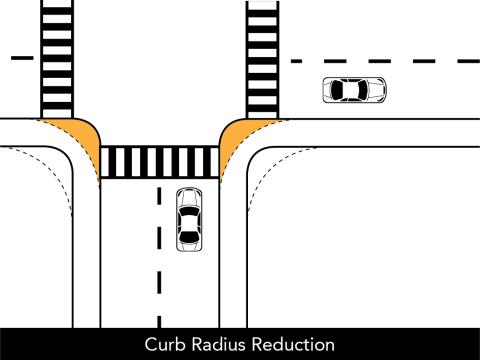
Making curb radii smaller at intersections forces drivers to slow down and creates shorter distances for pedestrians to cross the street, generally improving pedestrian safety.The radius of a typical local road curb is 8.0 metres and 9.0 metres for collector roads. This radius is sufficient for the majority of larger service and emergency service vehicles, and forms part of our current Engineering Standards. Curb radius reduction will be considered for all road rehabilitations.
Curb extension
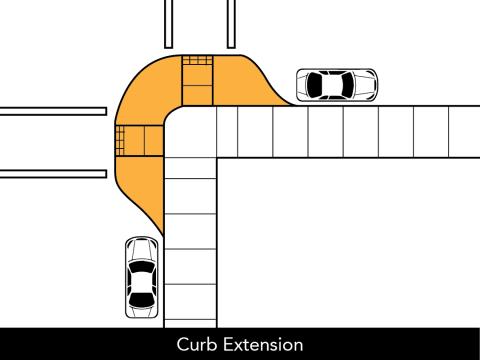
With curb extensions, the curbs are extended out, creating a pinch point as the intersection approaches. The curb extensions shorten the crossing distance for pedestrians, thereby enhancing pedestrian safety.Curb extensions are effective, however, they must be designed differently to accommodate roads with bicycle lanes.
Centre median/pedestrian refuge islands
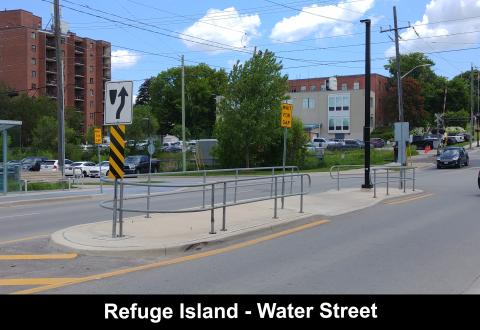
The Town has two pedestrian refuge islands - one on William Roe Boulevard, just east of Yonge Street and one on Water Street, just west of Doug Duncan Drive.The pedestrian refuge island allows pedestrians to cross one lane at a time with an area of safe refuge in between. Refuge islands are very effective for locations where trails and roads intersect.
S-shaped curve extensions on the road
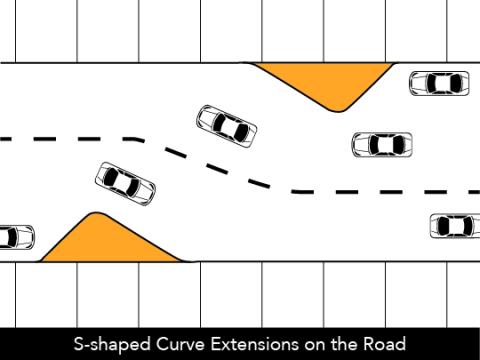
S-shaped curve extensions can be built into the road to slow down traffic. The Town does not currently use S-shaped curve extensions on local roads, however they could be considered for future use. As with speed humps, these S-shaped curves require placement in groups of three or four. To be most effective, the curves should be constructed on roads with moderate traffic. S-shaped curves constructed on roads with low traffic provide poor results, as motorists tend to drive down the middle and not closer to the right curb line.
Lane narrowing (construction)
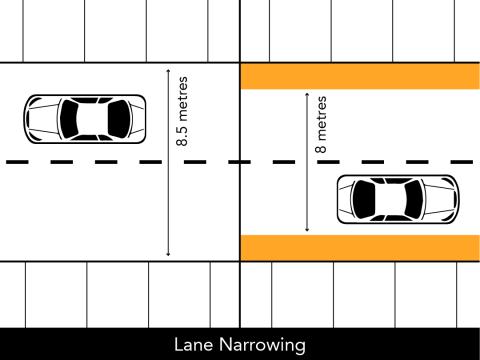
Physically narrowing lanes is an effective traffic calming measure. With new construction projects throughout Newmarket, the Town has been narrowing the travelled portion of existing roads from 8.5 metres to 8.0 metres for local roads, and 9.7 metres to 9.0 metres for collector roads. This is the current standard for new subdivision construction.
Motorists and pedestrians must work together to reduce safety risks. Although collisions involving pedestrians are generally declining, on average, one pedestrian is involved in a collision every month in Newmarket. The ideal goal is zero collisions.
Communication and education
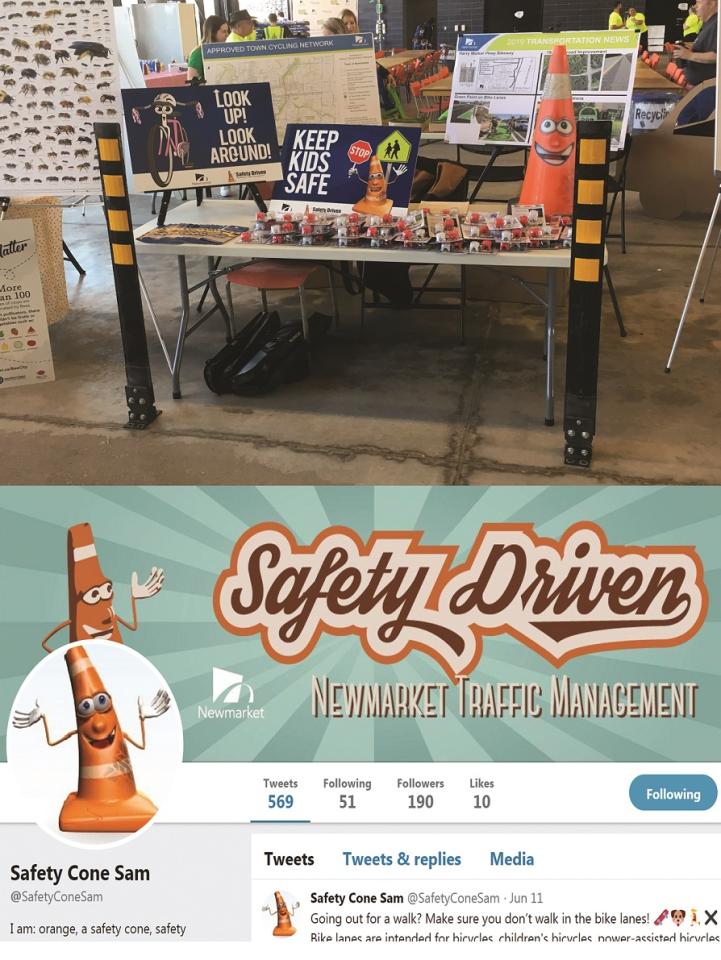
Pedestrian safety is promoted through Town's overall "Safety Driven" campaign, featuring safety mascots Safety Cone Sam and Belle the Bike. The Town educates residents on pedestrian safety through:
- The Town's website newmarket.ca/safetydriven
- The Town's Twitter accounts @SafetyConeSam and @TownofNewmarket and through the Town's Facebook page @TownofNewmarket
- Displays at Town events
- Safety education materials ( such as pamphlets, colouring books and comics)
- Advertisements in the Town Page of the Newmarket Era and Snapd
- Media releases, public service announcements and articles in the Town's Newmarket Now e-newsletter
- Lawn boulevard signs
- Educational videos
Motorists and pedestrians must work together to reduce safety risks. Although collisions involving pedestrians are generally declining, on average, one pedestrian is involved in a collision every month in Newmarket. The ideal goal is zero collisions.
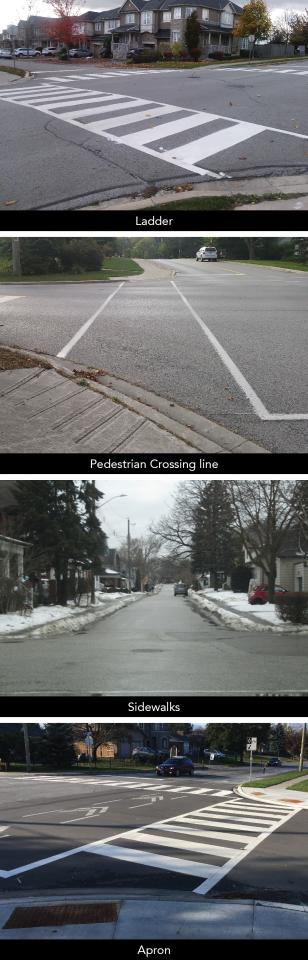
Physical improvements
The following are a number of low cost, physical improvements that can greatly add to pedestrian safety.
Ladder markings at intersections
Chosen intersections receive additional pavement markings in the form of the ladder-style pedestrian markings. For the motorist, ladder markings provide better visual contrast between the pedestrian and the roadway.
Pedestrian crossing lines
Currently, the Town has a policy in regards to the installation of stop bars and pedestrian crossing lines. These markings are generally found at all-way and three-way stop controlled intersections, and select minor stop controlled intersections. Intersections located directly on a school route take precedence. The ultimate goal is to install stop bars and pedestrian crossing lines at all intersections. Not only do the crossing lines provide guidance to pedestrians and motorists, they also improve visibility at intersections. Lateral lines painted across the road generally get a higher motorist response than signage or in combination with signage.
Sidewalks
The Town has been installing sidewalks on one side of local streets during reconstructions, (mainly in the older areas of Town) however, there are a number of collector roads which currently have a sidewalk on one side only. Some of these streets are not scheduled for reconstruction and sidewalk placement for many years. To increase pedestrian safety, a program is needed to construct sidewalks on collector roads with only one sidewalk. Priority must be given to locations near school sites and other areas of high pedestrian activity.
Aprons
How a sidewalk intersects with the roadway is very important. A sidewalk apron is a widening of the sidewalk at an intersection to allow pedestrians a convenient and safe location to cross the road. At intersections, most sidewalks have a wide apron for accessibility and ease of crossing. However, some intersections (especially where additional stop controls have been constructed) may not include an accessible apron. A program is required to address this issue, to provide accessibility and ease of use.
In 2014, the Town adopted the Official Plan Amendment #11, which updated active transportation facilities (bike lanes, trails and paths) for cyclists and pedestrians. Most on-road bike lanes are located on residential collector roads throughout Newmarket.
The purpose of the Active Transportation Plan is to:
- Provide different ways to travel around Town (walking, cycling etc.)
- Provide protected bike lanes to increase safety for cyclists
- Provide traffic calming to the residential collector streets by narrowing the travel lanes (narrow lanes typically slow down traffic)
As part of the Active Transportation Implementation Plan, dedicated bike lanes, flexible bollards, signage and other measures were installed throughout Newmarket in 2017. Additional measures will be added in the future.
The Active Transportation Plan includes:
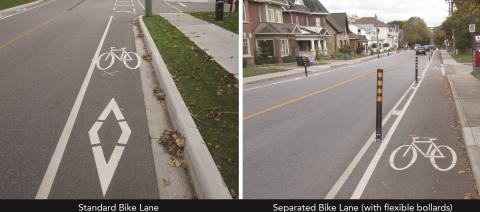
- Standard bike lanes
- Separated bike lanes (with flexible bollards and planters on Millard)
- Multi-use path (Eagle Street West)
- Advisory lanes (Park Avenue)
- Signed routes (Main Street)
The measures have been implemented to create a separation between cars and cyclists/pedestrians and to improve safety.
If you should find any of the above are not in an acceptable accessible format, please contact the Town of Newmarket at 905-895-5193 or email info@newmarket.ca.